Jennifer Ng
Here, 'Thingness' holds objects found, created, co-created with others, as well as things made for performances, and their remnants.There were some strange, imperfect, fun, even unbelievable stuff in the mix. Some were "beautifully made", as friends would sometimes say, some I have pulled out from my treasure hunts in the dumpster, some were secretly hidden until they were exposed; all of them became part of what made the artist I am today. So, to all the 'things', and to all the people I met along the way as I accumulated these 'things', thank you! Note : items not arranged in chronological order.


Materials: Beaded shoes [Kasot Manek]
"You must walk in a slow swaying gait [Mesti jalan lenggang-lenggok]"
The shoes were placed in several sites in the English county of Worcestershire, and juxtaposed with scenes of British’s landscape, street scenes of houses, people, rivers, cars and roads, mailboxes, and canal barges. The shoes and the specific landmarks were brought in and out of focus intermittently, to connect and highlight the physical reality of their co-existence, sharing the same time and space. Each time the focus shifts away from the shoes, the viewer’s vision is thrown away into the distance, like an instant reaction towards something interesting somewhere else. When the vision is brought back onto the shoes, it feels as though the gaze is brought back once again to a near focus, back to an absent body.
Studies of 'ghost embroidery'


_edit.jpg)


The illogical Progression of the Mythological Bird project
Infinite Bird : The Bird That Never Landed
Materials: Moving images with digitally manipulated bird whistles (created by Music By Numbers) , made from strips of painted papers, painting studies of Phoe's life.
This is the story about the Infinite bird, Phoe. Having lived 600 years, chronological time no longer makes sense to her. This time, she started to notice her tattered and fraying feathers. It was horribly uncomfortable; she did not feel like herself anymore. She used to look gorgeous, colourful and regal, but she felt the need to carry on despite whatever is happening to her. With unyielding determination, she would tend to her wings every night by licking her feathers, straightening and patching together bits that were precariously hanging on its ends. She continued patching through the damage and as a means to stop herself from further disintegration. Her persistent efforts soon paid off and she was able to hold her frail frame together, and she flew fly. For another 600 years, she travelled all around the world…but never once landed.


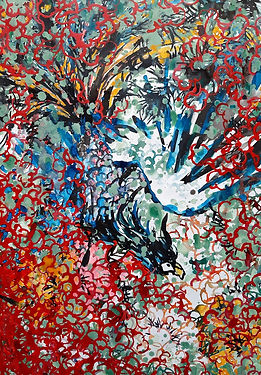
The Mythological Bird Came To Visit Me By Posting Itself
In Conveniently Sized Envelopes
140 (H) X 185 (W) cm
The Irony of the Mythological Bird
in a Garden Full of Blessings
99( H) x 68 ( W) cm


The Mythological Bird's Raining Blue
150.5 (H) x 58.5 (W) cm

.jpg)


.jpg)

Thing-ing
Materials : Cement, plaster & found materials
Exhibited at the National Institute of Education Art Gallery, Singapore
Bill Brown (2001) states that a thing is temporalized as the before and after of the object. A thing exists before an object is formed, and again becomes a thing when it ceases to be an object, for example in the instance of an object that breaks down or malfunctions. He mentioned that an object is transparent while a thing is opaque. If we focus on interacting with the materiality of a 'thing', we would be able to access the full condition of this material than otherwise. Whether we realise it or not, we are constantly surrounded by many things regardless of where we are and our relationship with them. We definitely own and need many things for our day-to-day operations.
This work seeks to explore the dis-connections between things and objects by studying the trajectory of the object-yet-to-become to the state of non-objectness.
Studies of a different kind of space : Lanterns
Chinese ink, gouache on fabric, metal boning & copper wires

Infinite Loop
80 (H) X 157 (Circumference) cm

Cicada's Visit
80 (H) X 157 (Circumference) cm


A Practice-based research Exposition at the end of my PhD studies , presented at the Birmingham School of Art, Birmingham City University, UK.


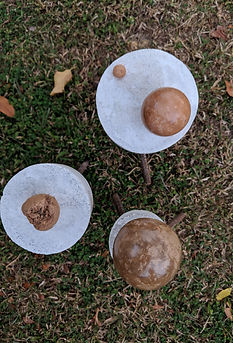

Terra Fermata #1, #2, #3
Materials: Earth, metal, and cement
This work was made with my collaborator in Singapore, Wilson Goh.
Our title is derived from the Latin term used to describe solid ground, Terra Firma, and Fermata, a musical term used to mean for the note to be sustained for a period of time at the discretion of the performer. In melding the two terms together,we hope Terra Fermata to mean for Earth (Terra) to remain for as long as it is intended, and to also recognise humanity’s influence on that duration.
The work itself is centred around various balls made solely out of fresh soil found within the estate in which the artists reside. The different finishes on the balls highlight some of the hidden properties of soil. They are juxtaposed against a base made of industrial cement and metal reinforcement rods to present a physical metaphor for the myriad treasures the earth offers that most do not stop to consider or even begin to see when we keep to ourselves within our urban landscape.



Pulling Grass
Materials: Installation, Elastic cords & dye
Variable dimensions
Exhibited at the Singapore Art Museum,Yavuz Fine Arts ‘Between Conversations’, and Ion Gallery ‘Waxing, Waning’.
This work is a metaphor for the pressures and demands faced by our learners in the current education system. I explored the concept of time and stress by completing each crochet row within a time-frame of five minutes. Like tender young blades of grass under pressure, they were ‘stretched’ and compelled to grow too quickly and often before their due time. What are we compromising? But, does stretching grass actually make it grow? What would happen instead, if we allow grass to grow at its own pace? This work questions the value of and implication of the education systems the time it was made.

Large - 28.5 (H) x 15 (D) cm, Medium-33.5 (H) x 12 (D) cm, Small - 33 (H) x 8(D) cm
Breathing Space
Materials: Installation art with wool on sticks
Variable dimensions
Exhibited at The Art Gallery, National Institute of Education, Singapore
‘Breathing space’ was designed as a woven enclosure made up of mainly wool yarn forming five woven panels, held up by five straight willow branches and suspended from the ceiling. The idea of ‘Breathing Space’ stemmed from a private performance with an 'invisible' object, which led to several long walks.. I took note of potential materials/objects that had the slightest connection to ‘breath’/ ‘breathing’. I noticed small holes on dried leaves, a cracked granite path and hairline cracks on a cemented wall. I observed a partially emerged root protruding from a footpath and a gaping hole on a rotten tree stump. I then began observing my everyday environment more intently, with the intention of finding ways to breathe.


No Need To Ask, These Are All Treasures
Materials: Cement and found objects from site
‘One By One Metre Space Exhibition
A Sungei Market Art Project
Community Based Art Project
Singapore Art Week 2016
Supported by National Arts Council
‘Survey: Space, Sharing, Haunting exhibition’
The Substation, Singapore
Diverse hodgepodge of bric-a-brac often seen laid out on tarpaulin sheets along this nostalgic haunt had faded into history. The paraphernalia of the disappearing flea market were brought to a closer attention of the public, as a poignant reminder of its resilient existence over eight decades.
Using site-specific materials interspersed with narratives from the Sungei Road Thieves Market, I created sculptures out of objects collected over a period of three months. The exhibition ‘One by One Metre Space’ recalled the 1m X 1m area allocated to each vendor at the market, a privilege that was eventually taken away. The historic ‘Thieves Market’, known for its notorious past, made way for the Jalan Besar MRT station (public transport) in 2017. This show questioned the use of our urban spaces and their intrinsic value. In the style of a grand curtain call, we invited the vendors into the exhibition space (just across the road) for the evening’s exchanges. As the night went, the artworks took on new meanings seen through the eyes of the people who once treasured, discussed, flaunt and commodified them.
%2C%202016%2C%20Mixed%20Media%20and%20Cement%2C%2043%20x%2021%20.jpg)

No Need To Ask, These Are All Treasures.
278(H) x 43( L) x 21 (W) cm

Treasures Series 1- 3 ( Top-Down , left -right), various dimensions


Got Your Name or Not?
A participatory art project presented by TAC about art and labour.
Materials: Cement, and miscellaneous
“Time as currency; Labour as art. Together everyone is an artist, and the work belongs to everybody.” - The Artists Company (TAC)
On26 April 2018, in Sinagpore,TAC explores the relationship between art and labour through Got Your Name Or Not?. The term ‘artwork’ often refers to the production of an art object or an art object itself. As part of the ‘participatory art’, TAC will employ expedient means to capture time as currency, labour as art. Here, artist’s individuality, style, and ownership are put aside. Participants are given an opportunity to be artists in an art show by committing their time and effort, where timestamps will record their artistic labour. It will be one’s physical presence that determines how much of the work one ‘owns’ at the end of the show. Each participant becomes conscious of the time, labour involved and immaterial and intangible value of these constructions, as they clock in/out, work on their art and develop a social bond with the artists.
The construction of relationships and artworks are what embodies this form of public art, where the art-making is set within a conceptual framework with a social objective. The interaction amidst laborious art tasks enables artworks to come into being through the execution of a set of instructions and a series of subsequent actions. Through Got Your Name Or Not? TAC asks the following questions: When two or more people are given the artistic license to decide where the work is going, how do they come to a consensus? Does an artwork need to come with an author? When is a work considered completed? Will an artwork ever be complete?
The public is sought to come forth to work in the art studio on specific dates beginning on 1st May (Labour Day), to enter the art space and participate in the frameworks or simple instructions that TAC has prepared. The participatory art making will happen collaboratively over SEVEN DAYS and clock in 49 HOURS.
Text from media release

.jpg)


Squish
Materials: yarn and bean bag filling
a soft sculpture placed at the Bedok Sports Centre carpark, exhibition organised by Arts in Construction, LopeLab
The large cubic beanbag awaits interaction, to offset the straight edges or boundaries that defines its physical existence. It seeks wonderous imagination and play.


Meet The People Session
A participatory work involving a sculpture workshop with cement, followed by public display of works. The event was organised by the OH open House.
The residents within and outside a quiet estate in Singapore, known as Potong Pasir were invited to participate in the 2 weekend workshop. Using cement as a metaphor for change, my collaborator and myself created a workshop to make sculptures out of industrial cement and engaged the public in conversations about the estate, particularly their
experiences of living in it and in some cases, had lived in Potong Pasir for some time. Many talked about how little change have occurred over the past three decades, whereas some lamented on recent development of the area and its irreversible loss of character and charm.


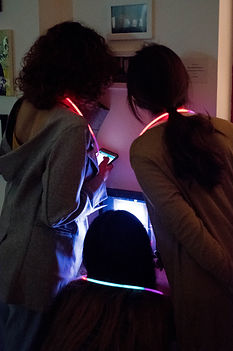


Texting Red and Green
A participatory work presented by TAC at the Stamford Arts Centre, Singapore, organised by the Wu Wei Performance Series
Materials: UV Light sticks and mobile phones
Communication is the act of conveying meanings from one to another using mutually understood signs and symbols. As sentient beings, we exchange information by speaking, writing or through other mediums. In our performance (TAC), we explore the liminal state in communication between individuals through the common system of texting. Using mobiles, demarcated groups of visitors will be invited to participate actively by responding to text instructions throughout the performance. Using the familiar medium of the Whatsapp Group Chat, we seek to release it temporarily from the dross of practicality and information sharing. Through subjugating its use as a tool of instruction and delivery of information; there is also the catharsis of our antagonistic relationship with this technology. We imagine that this use of technology can instead allow people to rely on non-verbal cues. Often times, the precariousness of texting lies in the gaps that occur when communicating, associating with assumptions and transfers that get lost in translation. The performance oscillates between connection and alienation, creating artificial boundaries between people while making links through text messages. In response to the seemingly nebulous link with technology, we attempt to create an interactive platform which seeks to fill in the gaps left behind by the false connectedness of instant messaging.
Photos Marcus Che
Sembagraphie
An improvisional performance performed at the Nanyang Academy of Fine Arts with Tang Da Wu and his performance group -Stitchen Haus da Opera
Photos The Fave Archive


Esplanade Theatres by the Bay
With Tang Da Wu and Station House da Opera
Station House da Opera presents the image of Vincent van Gogh’s painting, Wheatfield with Crows through the act of embroidery. Painted in 1890, the painting is believed to be van Gogh’s last work and thus deemed as one of his most significant paintings. Encapsulated in the above quote from van Gogh is a message that Tang Da Wu, the founder of Station House Da Opera, hopes to convey to all: that Vincent van Gogh, who died at the age of 37, was nonetheless loved by many, including his brother Theo and sister-in-law Johanna van Gogh, as well as his good friends, the postman Joseph Roulin and his doctor Dr Paul Gatchet. Vincent treasured all these relationships and the love that was showered upon him, and he gave back to society in the best way he could during his short life. The performance is inspired by Vincent van Gogh’s pure intentions in life and drawn from the endearing letters written to his brother, Theo van Gogh.


Invited to conduct a performance art workshop for the elective art module at the National University of Singapore


